
Surf Essaouira · Blog
SURF ESSAOUIRA – Surf Lessons, Kite Lessons & The Ultimate Atlantic Escape
Where whitewashed walls lean into Atlantic spray
Essaouira does not ask you to choose between culture and ocean. On one side of the ramparts, thuya wood workshops and Gnawa rhythms fill the medina; on the other, the Atlantic rolls onto soft sand with a reliability that has earned the town its Wind City nickname. That double life is the real invitation: you can learn to stand on a wave in the morning and still have time to wander UNESCO-listed alleys before dinner.
Travellers who arrive chasing only one sport often leave surprised. The bay is shaped for beginners and improvers, yet the same coastline feeds afternoon wind sessions that feel like a second holiday stacked on the first. Surf lessons teach you to read swell and tide; kite lessons teach you to partner with the Alizé. Together they form an escape that is athletic without being punishing, social without being chaotic.
This article is written for people who want that dual rhythm explained clearly — how a day unfolds, where coaches take you, how seasons change the feeling of the water, and how Surf Club Essaouira stitches lessons into a week that still leaves room for mint tea on a rooftop. If you are planning your first Morocco ocean trip, or returning with a friend who prefers kite while you prefer surf, the Wind City is built for both of you.
Call it an Atlantic escape rather than a checklist destination. The goal is not to tick every beach on the map; it is to feel salt on your skin twice in one day, once under glassy morning light and once under a powered afternoon breeze, then to walk back into town with enough energy left for grilled fish at the port. That loop — water, culture, rest, water again — is what keeps guests booking return flights.
Why this bay becomes an ultimate ocean playground
Geography does half the coaching for you. The Mogador islands sit like a natural filter off the bay, softening raw Atlantic energy before it reforms across sandy banks. What reaches the main beach is often rideable foam and friendly faces rather than punishing closeouts, which is why first-timers progress faster here than on reef-heavy coasts where every mistake has a sharper consequence.
The Alizé trade wind writes the daily timetable. Mornings frequently open cleaner and lighter — the window coaches protect for surf lessons — while afternoons fill with side-onshore breeze that turns the same shoreline into a kite classroom. Soft sand underfoot means safe launches and soft landings; wide beach real estate means teaching zones that do not collide with fishing boats or crowded peaks if the team plans well.
Add a temperate microclimate and you understand the playground label. Summers stay cooler than inland Morocco; winters stay milder than northern Europe. You can train in a comfortable wetsuit most of the year, hydrate between sessions, and still explore the medina without collapsing from heat. The Atlantic escape is not a remote camp cut off from town: it is a beach school with a living city attached.
Compared with single-discipline hubs that specialise only in heavy surf or only in extreme wind, Essaouira rewards mixed weeks. Couples with different comfort levels can share a base. Families can book soft-top mornings and watch older teens try kite later. Solo travellers meet both lineups and launch zones in the same social bubble. The playground works because it is flexible, not because every day is epic — honesty about average days is part of the charm.
Surf Club Essaouira runs from that practical reality: match the morning to swell and tide, match the afternoon to knots and direction, and never force a sport when the ocean says no. An ultimate escape is still an ocean escape — respect comes first, then progression, then the photos on the rooftop.
The dual-sport day: surf glass, then kite breeze
Picture a day that refuses to be only one activity. You meet the team early, stretch on the sand, and paddle into whitewater while the bay is still relatively quiet. After the surf debrief, you eat, rest, maybe nap or stroll the Skala. When the wind builds, you return for a kite lesson that uses the same beach knowledge under a different board and canopy. By sunset you have trained balance, timing, and wind awareness in one loop.
That rhythm is the heart of the Atlantic escape angle. Surf lessons sharpen ocean literacy — rips, peaks, priority, how foam differs from green faces. Kite lessons add power management, body-dragging confidence, and the feel of a side-onshore breeze that pushes you back toward shore rather than out to sea when conditions are chosen well. Skills transfer: better balance from surfing helps waterstarts; better calm under kite lines helps you stay composed when a set rolls through a mixed zone.
Not every calendar day will deliver perfect dual sessions, and a good school will say so. Light wind afternoons become yoga, medina time, or an extra surf tweak. Huge winter mornings may keep kite for another window. The point is the design of the week: you plan for two sports sharing one coastline, not for a rigid promise that ignores the forecast. Guests who accept that flexibility usually progress faster because they stop fighting the sky.
Logistics matter as much as romance. Soft-tops, wetsuits, helmets, harnesses, and radios stay near the beach so you are not dragging bags across town between sessions. Coaches at Surf Club Essaouira coordinate who is in which group so teaching zones stay clear. You spend energy on learning, not on guessing where to stand. That operational calm is what turns a dual-sport idea into a repeatable holiday pattern.
Surf lessons: warm-up, water time, mint-tea debrief
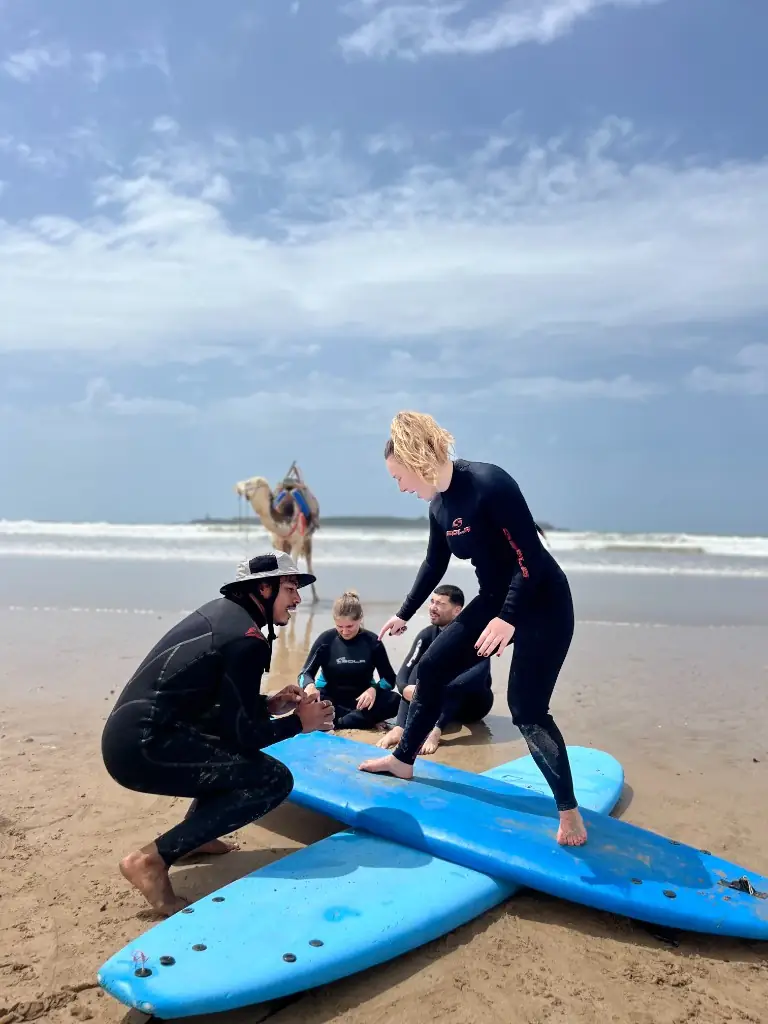
A Surf Club Essaouira surf lesson is built as a short story with three acts. Act one happens on the sand: dynamic warm-up for shoulders, hips and ankles, a safety talk about currents and signals, and pop-up drills on soft sand so your muscle memory exists before salt water scrambles it. Softboards chosen for your weight keep flotation high and impact low while you learn the motion of standing.
Act two is the in-water block. Instructors stay close in the teaching zone, helping you time paddles and catch whitewater first so balance arrives before ambition. As confidence grows, you learn to angle left or right, to paddle without nosediving, and to read which foam lines actually carry. Sessions typically last around two hours including briefing, which is long enough to tire you productively without frying beginners on day one.
Act three is the debrief — often with Moroccan mint tea — where coaches name what worked and what to fix next time. That pause matters. Without it, guests remember only adrenaline; with it, they remember a cue they can reuse tomorrow morning. The social warmth of tea also resets the nervous system before you decide whether the afternoon is for kite, rest, or another gentle surf tweak.
Spot choice follows the same honesty. The main bay is the everyday classroom: sandy bottom, multiple peaks, minutes from town. Walk south toward Oued Ksob and the banks can feel punchier when swell fills in — useful for improvers ready for more drive, still sandy underfoot. When the bay is messy or crowded, Sidi Kaouki offers a wider, wilder beach break about twenty-five minutes south, with space that rewards intermediate paddlers and still softens for coached beginners on mellow days.
You do not need to memorise every peak name before you arrive. What you need is a school that watches tide charts and wind apps, then picks Main Bay, Oued Ksob banks, or Sidi Kaouki because the water agrees — not because a brochure promised a fixed photo spot. That adaptive habit is how Surf Club Essaouira keeps lessons safe while still tasting the region’s range across a week.
Kite lessons: side-onshore Alizé, space to launch, IKO path
Kitesurf in Essaouira is not an afterthought bolted onto a surf school logo. The afternoon Alizé often arrives with a side-onshore angle that is genuinely learner-friendly when instructors choose the right stretch of beach. Side-onshore means that if you lose the board or need to body-drag, the breeze tends to help you back toward sand instead of dragging you into deep traffic — a safety geometry you should demand anywhere you learn.
Launch space is the second gift. Wide sandy beaches give IKO instructors room to set a clear wind window, keep bystanders out of lines, and run kite control drills without rushing. You start with theory and simulator work, move into body-dragging to feel power without the board, then progress toward waterstarts when control is stable. Helmets, impact vests, and well-matched kite sizes are part of a serious kit list, not optional theatre.
The Level 1–3 path gives structure. Level 1 focuses on safety systems, kite setup, and basic control on land and in shallow water. Level 2 builds body-drag confidence, board recovery, and first waterstart attempts under close coaching. Level 3 aims at independent riding in both directions, basic turns, and the judgment to know when not to launch. You may need several sessions at each stage depending on wind consistency and your athletic background — rushing levels is how bad habits calcify.
Surf Club Essaouira integrates kite days with the same daily honesty used for surf. If knots are light, you postpone rather than invent a dangerous session. If wind is strong but direction or crowd risk is wrong, coaches shift the teaching zone or delay. Guests who already surf often progress faster on balance; guests new to both sports still succeed when they accept that kite has its own learning curve and deserves fresh attention in the afternoon, not leftover energy only.
Rental and improver coaching exist for riders past first waterstarts who want local advice on gusty patterns, right-of-way near the bay, and which afternoons suit freeride versus freestyle practice. Whether you are booking a first discovery or stacking Levels across a camp week, ask for IKO-minded progression notes so you leave with skills you can reuse in other wind destinations — not only with a single lucky ride on camera.
How the seasons rewrite your Atlantic escape
Autumn often feels like the balanced chapter. Swell becomes more regular, mornings can stay clean, and water temperatures are still inviting with a full suit. It is a strong window for mixing surf lessons with kite sessions before winter energy arrives. Improvers chasing greener faces and beginners who want more than tiny summer foam both find useful days if they protect the early glass.
Winter brings the Atlantic’s bigger personality. Northwest swells can deliver powerful mornings for solid intermediates and advanced surfers, while teaching zones for newcomers stay carefully chosen. Wind can be lighter on some winter mornings, which is excellent for surf focus; kite windows depend on the week’s pattern rather than a summer-like daily guarantee. Pack a thicker wetsuit, booties if you run cold, and patience for stormy rest days that are part of a real ocean season.
Spring eases intensity while keeping workable swell and building afternoon breeze. Many travellers find March through May flexible for dual-sport weeks: enough wave shape to practice take-offs, enough wind days to push kite levels, and temperatures that still invite long medina walks. It is a practical season for couples sharing different goals inside one booking.
Summer is the classic Wind City postcard for kite and the gentlest surf classroom for first stands. Waves are often smaller and friendlier in the morning; the Alizé frequently strengthens after midday, turning the beach into a kite playground. Book early surf lessons, hydrate aggressively, use high SPF, and treat afternoon wind as the main event if freeride is your priority. A summer Atlantic escape is less about heavy barrels and more about repetition, confidence, and flying lines under bright sky.
Whatever the month, think in windows rather than slogans. The pro habit is simple: surf when the water is cleanest, kite when the wind is honest, rest when neither cooperates, and use town life as the fourth activity rather than a backup plan. Seasons change the mix of those windows; they do not cancel the dual-sport design that makes Essaouira feel like an escape instead of a single-beach grind.
Après-surf lifestyle: medina, port, rooftops and day trips
The Atlantic escape continues when the leash comes off. Essaouira’s medina — a UNESCO-listed maze of pedestrian lanes — rewards slow walking: silver jewellery, thuya wood scent, carpet stalls, and sudden courtyards of light. After a morning of paddling, that sensory shift prevents the week from feeling like a sports academy. You recover while still exploring.
The port is the lunch ritual many guests never skip. Choose fish from the stalls, watch it grill, eat with your hands while gulls argue overhead. It is simple, salty, and perfectly timed between a surf debrief and an afternoon kite briefing. Rooftop cafés add another layer: mint tea, ocean horizon, and the quiet satisfaction of muscles that worked honestly.
Evenings invite rampart walks at the Skala, where cannons face the swell and sunsets turn the islands into silhouettes. Live music and Gnawa heritage give the town a heartbeat beyond tourism brochures. None of this requires leaving your surf-kite base; it is woven into the same compact peninsula, which is why dual-sport travellers still have bandwidth for culture.
Day trips expand the map when energy remains. Sidi Kaouki for a wilder beach afternoon, a quieter coastal village pause, or — on the right swell week — a longer excursion toward legendary point breaks further south. Horse or camel rides along the dunes, short desert-edge experiences, and yoga focused on surfer shoulders all fit the après-ocean menu without competing with lesson progress if you schedule them intelligently.
Treat lifestyle as recovery infrastructure, not distraction. Sleep, hydration, and protein-rich meals decide whether tomorrow’s Level 2 kite drill feels possible. Surf Club Essaouira guests who pace the medina evenings instead of stacking late nights usually stand earlier, waterstart sooner, and enjoy the escape as a whole rather than as two exhausted sports bolted together.
Packing light for a two-sport week
You do not need to fly with a quiver to enjoy surf lessons and kite lessons here. Softboards, seasonal wetsuits, and school kite gear cover most first-week needs. Bring a sturdy swimsuit to wear under neoprene, reef-safe high SPF, a mineral face stick, sunglasses with a strap, and a quick-dry towel or poncho. A light windbreaker helps after sweaty sessions when the Alizé is still blowing on the beach.
Footwear can stay minimal: sandals for town, optional booties in cooler months if the school does not supply them for your size. Gloves are rarely necessary in summer and sometimes welcome in deep winter. If you already own a harness you love, ask whether bringing it helps; many guests prefer using school harnesses fitted on site for the day’s kite size.
Digital prep matters too. Screenshot meeting points, save the Surf Club Essaouira contact, and share your swimming confidence and any injuries when you book. Dual-sport weeks work best when coaches know you want mornings for surf and afternoons for kite — or the reverse on special swell days — so they can hold space in both programmes.
Leave ego out of the bag. Soft-tops are not a demotion; they are acceleration tools. Large learner kites are not vanity sizes; they are matched to weight and knots. The Atlantic escape rewards curiosity and repetition more than expensive personal equipment on week one.
Book your escape with Surf Club Essaouira
Ready to turn the dual-sport idea into dates on a calendar? Contact Surf Club Essaouira with your travel window, levels in surf and kite, and whether you want standalone lessons or a camp-style package with lodging partners. Ask for a sample day that shows morning water time, midday recovery, and afternoon wind training so expectations stay realistic.
Group lessons keep the vibe social and the price accessible; private or semi-private coaching compresses feedback when you only have a few days. Many guests combine three to six surf sessions with a kite Level block across the same week. Others surf heavily when swell is alive and shift emphasis to kite when the Alizé dominates — the school can rebalance if you communicate.
What you should feel after booking is clarity: where to meet, what is included, how cancellations work when wind or swell refuses to cooperate, and who to message on arrival. Professional hospitality is part of safety. When those details are clean, you arrive free to focus on the water.
Get ready to feel the water. See you in the lineup! The Atlantic off Essaouira is waiting with soft sand, filtered swell, and an afternoon breeze that turns one holiday into two. Surf Club Essaouira is ready to coach both chapters — and to hand you mint tea when the story of the day needs a closing line.
Book a kite lesson
This guide prepares your session. For coached water time in the bay, book a kitesurf lesson with gear included.